If you are asking how to learn music production, start with a computer, a single DAW and headphones, then finish small tracks. Basic recording and DAW navigation usually takes about 3–6 months of regular practice.
Picture a beginner who buys a controller, a stack of plugins and a second DAW before completing a song. This roadmap avoids that trap by putting finished tracks ahead of gear. Production is one skill within the wider world of live music culture, and for the full path from writing to releasing, see How to Make Music: A Practical 2026 Starter Guide to Writing, Producing, and Releasing Songs – Voiceoriginals.
Misconceptions that slow beginners down
Most early detours come from assumptions about gear, software and the order of study. The table sets four common beliefs against what production educators say, and what each means for your plan.
| Common belief | What educators say | Planning use |
|---|---|---|
| I need expensive gear before I can start. | Plenty of producers got their start with just a laptop and free software. | Delay purchases until a finished track shows what is missing. |
| I must master my DAW before studying production. | Musicians Institute states that you do not need to master a DAW before studying music production. | Learn the software while making tracks, not before. |
| I should sample several DAWs to find the best one. | Learning one DAW really well is advised over jumping between different software. | Choose a DAW once and stay with it through the whole plan. |
| Mixing is where production begins. | Mixing is usually learned after basic track building. | Build simple arrangements first; treat mixing as a later layer. |
The table draws on Wisseloord Academy’s guide to the stages of learning production and Musicians Institute’s study guide.
The pattern is consistent: the bottleneck is finished work and focused practice, not equipment or software choice. That raises the question of how long the learning itself takes.
How long learning music production takes
Expect months to reach basic competence and years to reach professional-level work. Wisseloord Academy describes the progression in stages:
- Basics, about 3–6 months. This is the time to get the hang of basic recording and navigating your DAW with regular practice.
- Exploration stage, 0–6 months. You learn software basics, how audio flows through your system, and how to finish simple tracks.
- Foundation stage, 6 months–2 years. The technical work arrives here: gain staging, EQ, compression and arranging.
- Mixing and professional level. Becoming decent at mixing takes around 1–2 years. Reaching professional-level production takes 3–5 years or longer, and the refinement stage of 3–5 years adds advanced mixing, basic mastering and efficient workflows.
For a sense of effort rather than calendar time, one producer reports that it took roughly 500 hours of dedicated focused attention to learn, create and produce a first album. Treat that as one person’s account, not a benchmark. wikiHow’s guide makes the broader point that it takes months and years of study and practice before you really start seeing results.
The sensible target for the plan below is therefore the exploration stage: comfortable software skills and several finished simple tracks. Mastery comes later, so the next question is what to put first.
What to learn first
Learn your software by finishing simple tracks, and add theory, arranging and mixing in small, separate doses. These habits fit that approach:
- Finish simple tracks. The exploration stage centres on software basics and completing straightforward pieces, so a short complete track teaches more than an endless loop.
- Recreate songs you know well. Recreating simple songs you already know teaches song structure and basic mixing, which makes it a practical way into arrangement.
- Listen critically. Musicians Institute suggests choosing songs you know well and listening several times with a different purpose each time, for instance one pass for arrangement and another for mix balance.
- Spread topics across days. wikiHow lists music theory, mixing, mastering and arranging as study topics, and they can be studied on different days rather than all at once.
- Understand MIDI early. MIDI records which note was played, when, how long it lasted and how hard, rather than audio, so the sound can be changed later. That flexibility makes MIDI a forgiving way to start building parts.
With the study order settled, the remaining decision is what to buy, and how little you can get away with.
Beginner tool list
A beginner setup can be extremely simple. Musicians Institute says you may initially need only a computer, a DAW and headphones, with other items depending on what you want to create. Everything beyond that is optional.
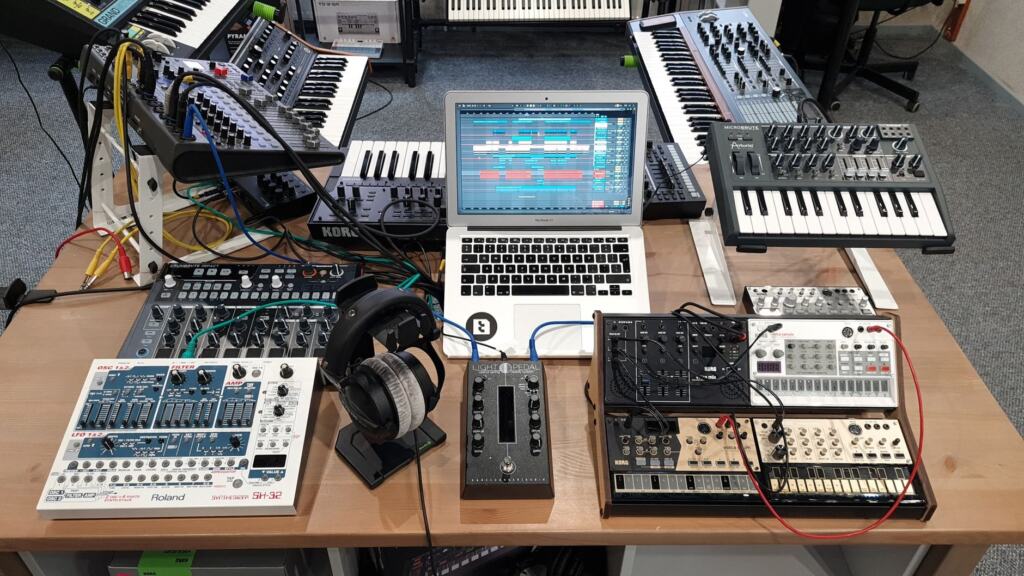
- Computer and DAW. Wisseloord Academy names basic software like GarageBand or Reaper as enough to get started. Pick one and learn it thoroughly.
- Studio headphones. Every beginner list consulted names decent headphones. They are the first purchase worth thinking about.
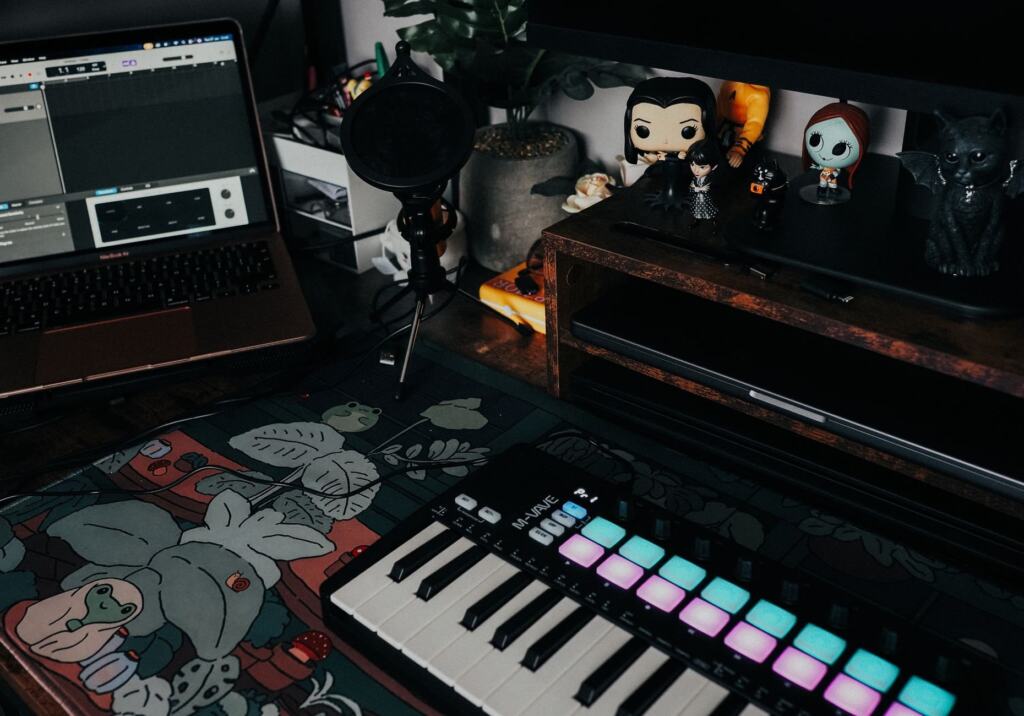
- MIDI keyboard. MIDI keyboards are commonly used to enter chords, melodies, bass lines and drum parts. wikiHow presents a DAW and a MIDI controller as essential starting tools, and one producer’s first purchase, a $99 AKAI MPK mini, shows the entry price of that route. Musicians Institute’s minimal setup leaves the keyboard out, so it suits you if you would rather play parts than draw them in.
- Audio interface and microphone. wikiHow lists a good microphone and an audio interface as equipment to invest in, and one producer describes headphones and an interface as essential for most beginners. Buy them when your projects involve recording sound sources.
The weekly plan
The plan runs for three months, with each month following one of the learning stages above. Keep sessions short and regular, because regular practice is what the timelines assume. Each week ends with an exported file, so progress is visible and you can compare it against reference songs.
First month: software and simple tracks
- First week: learn to record, import, edit and export in your DAW, and build a simple drum loop.
- Second week: add a chord progression and a bass line, using a MIDI keyboard or by drawing notes in.
- Third week: arrange the loop into distinct sections and export a short complete track.
- Fourth week: recreate a simple song you know well, matching its structure section by section.
Second month: levels, EQ, compression and arrangement
This month covers the foundation topics. Wisseloord Academy advises getting comfortable with basic EQ and compression before exploring fancy effects, so the plan keeps processing plain.
- Fifth week: practise gain staging on your recreated song, setting each channel’s level before touching any effect.
- Sixth week: use basic EQ to separate parts that compete for the same space, and note what each cut changes.
- Seventh week: add basic compression to drums or bass and compare the result with the unprocessed version.
- Eighth week: sketch where each section should rise or fall, then rebuild an earlier track to follow that map.
Third month: listening, rough mix and sharing
- Ninth week: replay a reference song several times, each time with a different focus, and write down what its arrangement and balance do.
- Tenth week: start an original track and build it fully before you begin mixing, in keeping with the usual order of learning.
- Eleventh week: make a rough mix of that track, then compare it against the reference and list specific differences.
- Twelfth week: finish and export the track, share it with peers, ask for comments on specific elements, and begin the next one. If a genre project helps you focus, Make Lofi Music: A Practical Step‑By‑Step Guide To Chill Beats In 2026 – Voiceoriginals walks through one.
Afterwards, repeat the cycle with harder targets. The foundation stage runs well beyond this plan, so use your journal of exports to decide what to deepen next.
Frequently asked questions
| Question | Answer |
|---|---|
| How long does it take to learn music production? | Basic recording and DAW navigation takes about 3–6 months of regular practice, according to Wisseloord Academy. The same source puts decent mixing at around 1–2 years and professional-level production at 3–5 years or longer. |
| Do I need a MIDI keyboard to begin? | No. Musicians Institute describes a beginner setup as possibly only a computer, a DAW and headphones. A keyboard becomes useful when you want to play chords, melodies, bass lines or drum parts rather than draw them in. |
| Should I study music theory before touching a DAW? | Not necessarily. wikiHow lists theory alongside mixing, mastering and arranging, and these topics can be studied on different days alongside hands-on production. |
| Do I have to master my DAW first? | No. Musicians Institute states that you do not need to master a DAW before studying music production, so you can learn the software while making tracks. |