

The best podcast name ideas tell listeners what to expect, stay short and pass an availability check before you commit. Choose a clear name aimed at a specific audience, then test it aloud and on mock cover art.
This guide sits within our wider coverage of audio media and podcasts. It moves in a practical order: what a name has to do, how to build a shortlist, formulas by genre, availability checks and a testing routine.
What a podcast name has to do
A podcast name works as a label, a promise and a search term at once. Spotify’s creator guidance says a name should tell people what to expect, and Shopify adds that the name and cover art together should give the audience a sense of the show before they press play. In a directory the name sits beside the artwork, so the two need to say the same thing.
Clarity and audience
Specific beats broad. Spotify notes that a name speaking directly to a specific audience can often work better than one trying to appeal to everyone. Its own illustration shows the cost of the opposite: a listener faced with several shows called “The Garden Podcast” cannot tell them apart. If your topic is crowded, narrow the audience or the angle until the name could belong to only your show.
Podcast Movement suggests starting from a word or phrase that describes your podcast and choosing specific words rather than vague ones. A clever-only name suits a creator whose audience already knows them. A new show without that following usually does better with a name that explains itself.
Length and simplicity
Short names travel better. Shopify says a concise name is easy to remember, to mention to friends and to search for. Hubhopper puts the ideal at under four words and warns that when people meet something complex for the first time, their attention drops away. Treat under four words as a sensible ceiling for display and recall, not a target; a couple of strong words is often enough.
- Avoid generic labels. A name that fits many shows in the same topic fits none of them in particular.
- Avoid complexity. Hard spellings and long phrases make the name harder to say, type and recall.
- Avoid profanity. Podcast Movement warns that it can cause a show not to be approved by various podcast directories.
Building a shortlist
A shortlist comes from a clear topic statement and a pool of specific words, not from waiting for inspiration. Work in rounds, and keep every round short so that weak ideas die early.
- Describe the show. Write what it covers, who it is for and what format it uses, in plain sentences.
- Pull out the words. Underline the specific nouns and verbs that your ideal listener would actually use, following Podcast Movement’s advice to describe the show with specific words.
- Pair and mix. Combine topic words with an emotional or literal hook, and try each pair in short phrases of a couple of words.
- Score honestly. Rate each candidate for clarity, memorability and discoverability, and favour names that score steadily across all of them rather than excelling at one.
- Prune. Drop anything that needs an explanation, then keep a few alternates in case an availability check removes your favourite.
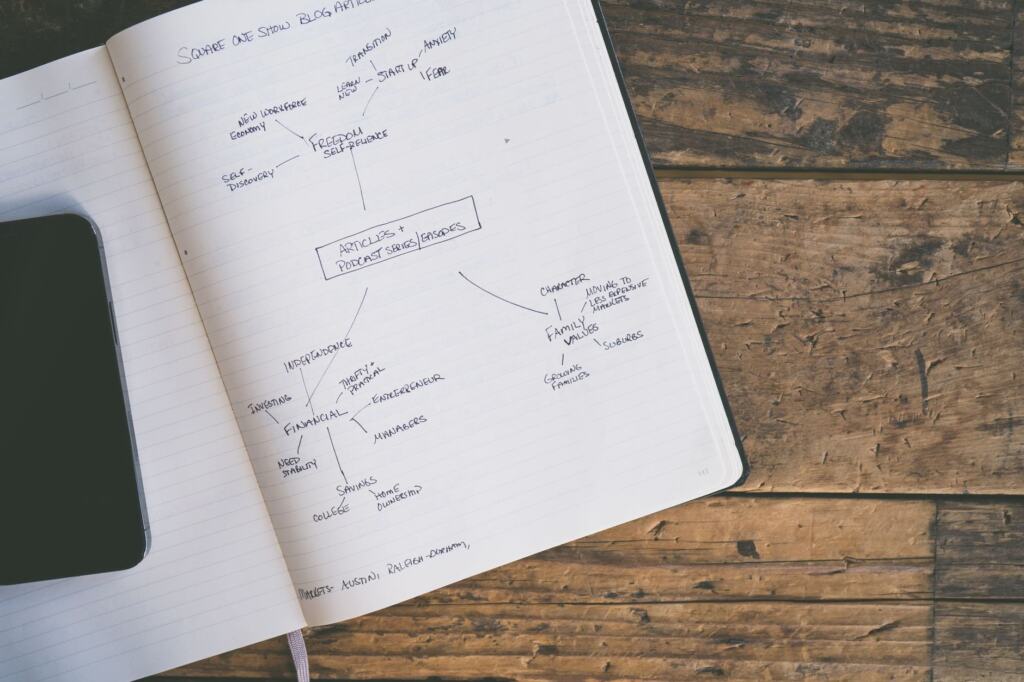
Mapping related words visually helps when the pool feels thin, because the links between topic, audience and tone often suggest pairings you would not list in a straight line.
Name formulas by genre
A formula gives a brainstorm structure, and the right one depends on the genre and on how much listeners already know about you. The table below pairs each genre with a pattern, example names to adapt and a note on when the pattern fits.

| Genre | Formula | Example names | Planning use |
|---|---|---|---|
| Business, CEO monologue | Role or setting + broadcast word | Executive Insights, Boardroom Broadcast, CEO Soapbox | Suits a leader speaking alone; the role word tells the audience whose voice to expect. |
| Business, interview style | Topic + conversation word | Founder Conversations, Operator Talk | Suits guest-led shows; the name should signal that other voices appear. |
| Lifestyle | Daily activity + hook | Daily Declutter, Home Reset | Suits practical shows for a defined audience, such as busy households. |
| True crime | Evidence word + place or object | Cold Trail Files, Hidden Threads | Suits narrative cases; avoid wording that could be mistaken for a single named case. |
| Comedy | Playful pairing or alliteration | Mic Break, Coffee & Cackles | Suits personality-led shows; the sound matters more than literal description. |
| Host-led | Host name + topic | Maya on Money | Suits a presenter who is already the draw; weaker for a brand-new host. |
Shopify’s naming guide supplies the CEO-monologue examples, and Spotify’s advice on naming for a specific audience underpins the rest; the other names are original illustrations to adapt, not existing shows to copy.
Choosing between formulas
Shopify groups business podcasts into five categories: CEO monologue, interview style, educational, co-hosted and industry news. Use that split as a prompt even outside business. Ask which format you are making, then pick a formula that makes the format obvious. A co-hosted show can use a name that suggests two voices, while an industry-news show benefits from a name that implies regular updates.
If two formulas both produce a good name, choose the one that is clearer to a stranger. Personality-led and playful names reward an existing audience; descriptive names do more work for a show that nobody has heard of yet.
Checking whether a name is taken
A name is only usable if the show can be listed under it and found without confusion. Run the checks in this order, and stop at the first clash so you do not invest in a name you will lose.
- Search the directories. Shopify recommends searching across major podcast directories, naming Spotify, Apple Podcasts, YouTube Podcasts and Amazon Music. Podcast Movement reports that Spotify will not accept a submission if its directory already has a show with the same title, so an exact match is a hard stop.
- Check the domain and handles. Spotify advises searching the name as a domain and a social handle as well as on podcast platforms. Shopify adds that you should verify availability on social platforms and secure the handle.
- Run a trademark search. Podcast Movement describes a quick Google search as an initial way to discover whether a name idea is already trademarked. Treat it as a first screen, and drop any name that closely resembles an established brand, even in a different field.
- Record the result. Note which alternates passed, so a clash costs you a swap rather than a restart.
A name that is free in directories but taken as a handle is not necessarily dead, but it forces a variant that listeners may mistype. Decide early whether you can live with that. Once the shortlist clears, the practical next stage is hosting and publishing, which our guide to Start Your Podcast For Free: A Practical Step-By-Step Guide (2026) – Voiceoriginals walks through.
Testing and deciding
Testing turns a preference into evidence. Spotify recommends two simple checks: say the name out loud, and create some mock cover art with it. Shopify makes the same point, advising that you consider how the title sounds when spoken aloud and how it looks alongside the artwork.
The spoken test catches names that are awkward to say, easy to mishear or too close to another word. The mock-art test shows whether the name fits a small cover on a phone and still reads clearly next to the image.
Add a comprehension check of your own. Show a few people only the name and ask what they think the show is about. If their answers cluster around your topic, the name is doing its job. If they guess several different subjects, the name is ambiguous, however good it sounds to you.
When two names perform about equally, pick the shorter and simpler one, in line with Hubhopper’s warning about complexity. Then document the name, any subtitle and the reason you chose it so that everyone who works on the show uses it consistently. With the name settled, you can move on to the audio itself with How To Record A Podcast: Step-By-Step Guide To Sound Great In 2026 – Voiceoriginals.
Frequently asked questions
Should a podcast name include keywords?
Yes, if the keyword is relevant and fits naturally. Shopify says thoughtful use of relevant keywords can improve discoverability, and Hubhopper says a keyword in the name can help the show appear in searches. Shopify also warns that keyword stuffing makes a title seem stale, spammy and forced. Hubhopper names Google Keyword Planner as a free tool for finding terms.
Should the word “podcast” be in the name?
Usually not. Spotify suggests saving the seven characters in “podcast” to make the show name more unique, since the platform already tells listeners they are looking at a podcast.
Can a podcast be renamed later?
Often, yes. Hubhopper notes that most hosting platforms let you change the name of your podcast. Because a rename can disturb recognition, it is better to finish the availability and listener checks first.
Can a name stop a podcast being approved?
It can. Podcast Movement warns that profanity in a title can cause a show not to be approved by various podcast directories, and a title identical to an existing Spotify show will not be accepted there.