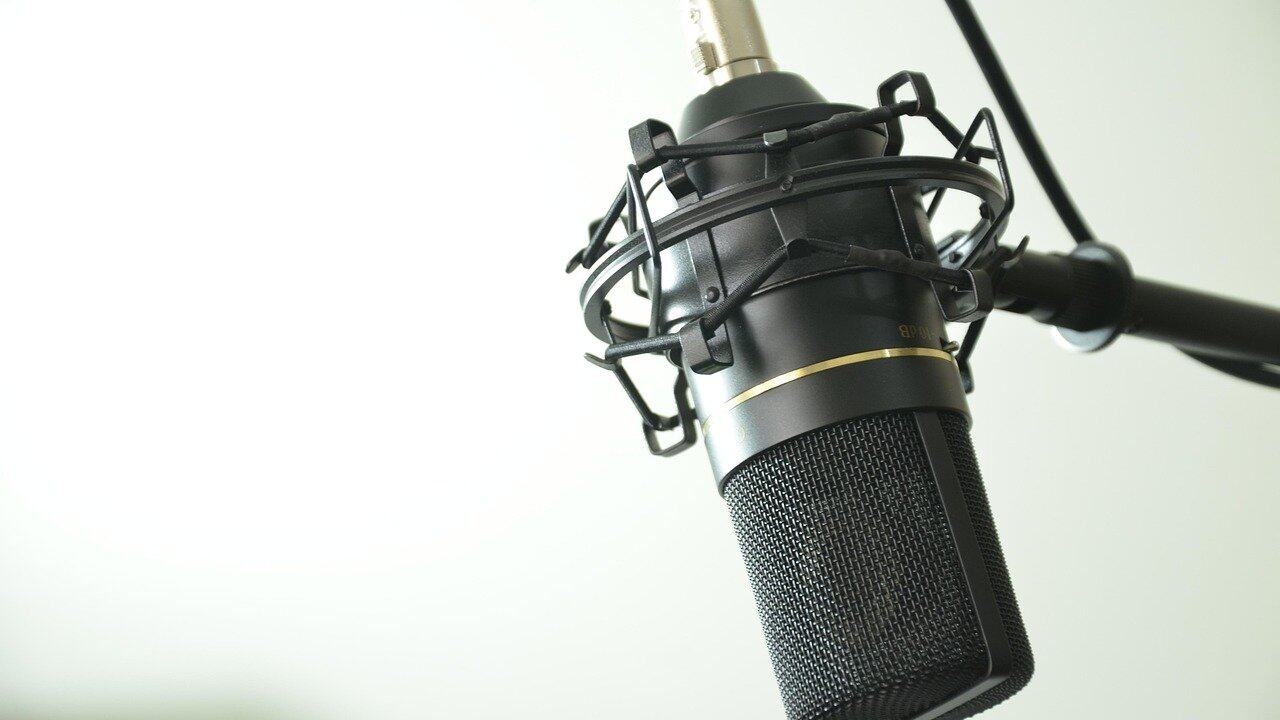
A cardioid polar pattern is a heart-shaped pickup that hears best at the front of a microphone and least at the back, so it favors the voice in front of it. It reduces off-axis noise rather than removing it.
This guide covers how the pattern behaves, how it compares with other patterns, and how to place the microphone for voice work. If you are still choosing a model, start with our overview of the best microphone for voice recording.
How cardioid pickup works
A polar pattern simply describes a microphone’s inherent directionality, meaning how its sensitivity changes with the angle the sound arrives from, according to RØDE. The cardioid is the most common of the directional patterns and takes its name from its heart-shaped response. Read around the microphone, the response runs in three stages:
- Front (0°). Sensitivity is highest here, so a voice or instrument aimed straight at the capsule is captured at full strength.
- Sides. Pickup from the sides is reduced, which is why a cardioid helps when you need to focus on one sound source.
- Rear (180°). Sensitivity is lowest at the back. LEWITT puts typical cardioid rear rejection at about -20 dB, roughly one tenth of the sensitivity.
LEWITT’s cardioid guide describes the pattern as most sensitive in the front and least sensitive in the back, which makes it very useful for sources directly in front of the microphone. LEWITT’s polar patterns guide describes a typical cardioid rear rejection, so rear sound is turned down, not silenced. A loud noise directly behind the microphone can still reach the recording.
Reading a polar diagram
On a polar chart the microphone sits at the center and the curve shows sensitivity at each angle. Each ring represents a 5 dB drop in sensitivity, according to RØDE’s polar pattern explainer. A curve that pulls in toward the center at the rear shows where the microphone is deaf. A curve that bulges outward shows where it is most receptive. Check the chart for the specific model, because two cardioid microphones can have different curves.
Cardioid compared with other patterns
The table shows what each common pattern hears and when it suits a job. For close voice work, cardioid is the practical middle ground between hearing everything and hearing a very narrow slice.
| Pattern | What it picks up | Planning use |
|---|---|---|
| Cardioid | Most sensitive at the front, least at the back; typical rear rejection about -20 dB | Single voice or instrument in front of the mic with noise behind it |
| Omnidirectional | The same sensitivity to sound pressure from any direction | Capturing a whole space rather than one source |
| Figure-8 | The same sensitivity at 0° and 180°, least sensitive at 90° and 270° | Sources at front and rear with the sides rejected |
| Supercardioid | Narrower front pickup than cardioid, with a small rear lobe; allows very high gain before feedback in live use | Tighter focus on stage when the mic must be aimed carefully |
Pattern descriptions come from LEWITT’s polar pattern guide, and the supercardioid pickup comparison comes from Elgato.
Choose cardioid when the person speaking is in one fixed spot and the unwanted noise is elsewhere. Choose a different pattern when the job is to capture sound from several directions, because a cardioid will deliberately turn some of that sound down.
Condenser and dynamic microphones
Capsule type decides whether you get a choice of pattern at all. Elgato notes that dynamic microphones are effectively fixed to a single pattern, usually cardioid. Microphones that let you switch between patterns are almost always condensers. Many budget and gaming-focused microphones ship with a single, fixed cardioid capsule.
In practice this simplifies shopping for voice work. A fixed-cardioid dynamic or condenser needs no pattern setting, and a switchable condenser lets you move to another pattern later if the job changes. If you only ever record one voice at a desk, a fixed cardioid is enough.

When to use a cardioid mic
Use a cardioid whenever one source sits in front of the microphone and you want less of everything else. LEWITT states that if you are recording a singer, cardioid is the standard polar pattern, and that it blends out poor room and background noise for a dry signal across most recording applications. Elgato calls it the default for most microphones built for solo voice work.
Voice at a desk
For podcasting, streaming and voice-over, Elgato says cardioid patterns cut down on room noise and background sound without requiring you to treat your room acoustically. That makes it the sensible starting point for a home setup. It is not a substitute for a quiet room, though. It lowers off-axis sound but does not erase it.
Live vocals
RØDE gives a vocalist on stage as the simple example. A handheld cardioid focuses on the singer while rejecting stage monitors and other performers. LEWITT adds that supercardioid allows very high gain before feedback in live use, so it is worth considering when a stage is loud and the singer’s aim is consistent.
When to choose something else
Pick omnidirectional if you want a room or a group captured evenly, and figure-8 if two sources face each other across the microphone. A cardioid is the wrong tool for both, because it favors the front by design.
Placement for voice work
Aim the front of the capsule at the mouth and the rear at the loudest unwanted source. LEWITT’s examples show the principle: position the back of the microphone toward a computer to reduce fan and click noise, or point the rear of a snare microphone at the hi-hat to reduce bleed. The same logic applies at a desk, so turn the back of the microphone toward the fan, monitor or window.
- Face the capsule. Point the front directly at your mouth, because off-axis sound loses bass response and fidelity more sharply, as Samson notes for cardioid microphones.
- Point the rear at the noise. Identify the loudest unwanted source and place it behind the microphone, where the pattern is least sensitive.
- Set your distance. Move closer for a fuller sound and farther away if the bass becomes heavy. The next section explains why.
- Stay on-axis while speaking. Drifting sideways changes the tone, so keep your head position steady through a take.

Proximity effect
Proximity effect boosts the low-frequency response as a sound source gets closer to the microphone, according to LEWITT. Elgato lists cardioid, supercardioid and hypercardioid as directional patterns that boost bass the closer you get to the capsule. Samson says the low-frequency rise can be large when the microphone is less than 12 inches from the sound source.
This can work for you or against you. A close-up broadcast voice gains warmth from it. A voice that sounds boomy usually improves when the speaker moves slightly back, rather than being corrected with processing. Because a cardioid is most sensitive in front, moving back also lets more of the room in, so find a distance that balances the two.
Setting up the rest of the chain
A cardioid microphone sets what gets captured, but the signal still has to reach your computer cleanly. The USB-C Audio Interfaces: The Practical Buyer’s Guide To Pro Sound In 2026 – Voiceoriginals covers that connection step for condenser and dynamic microphones alike. To understand how the interface turns your voice into digital audio, read What Is Sample Rate? A Clear Guide To Sampling Audio, Video, And Signals (2026) – Voiceoriginals.
Frequently asked questions
Does a cardioid microphone remove all background noise?
No. It turns down sound from the sides and rear, with typical rear rejection of about -20 dB per LEWITT, but noise in front of the capsule is still recorded at full strength.
Are dynamic microphones cardioid?
Usually. Elgato says dynamic microphones are effectively fixed to a single pattern, typically cardioid, whereas switchable multi-pattern microphones are almost always condensers.
How do I read the decibel figures on a polar chart?
Each ring on the chart represents a 5 dB drop in sensitivity, per RØDE. In level terms, LEWITT explains that +6 dB doubles the signal strength and +20 dB gives 10 times the signal.
Why does my voice sound bassier up close?
That is the proximity effect. Directional patterns boost bass as the source nears the capsule, so a little more distance reduces it.